Total Resource Management
Project 3.1 of the new Cattle and Beef Quality CRC
TRM prototype code in JAVA - run it directly from your browser. You may be prompted to download free Java run-time software from Sun Microsystems.
Click here to start: http://tgrm.une.edu.au/trm/java/trmfat.html
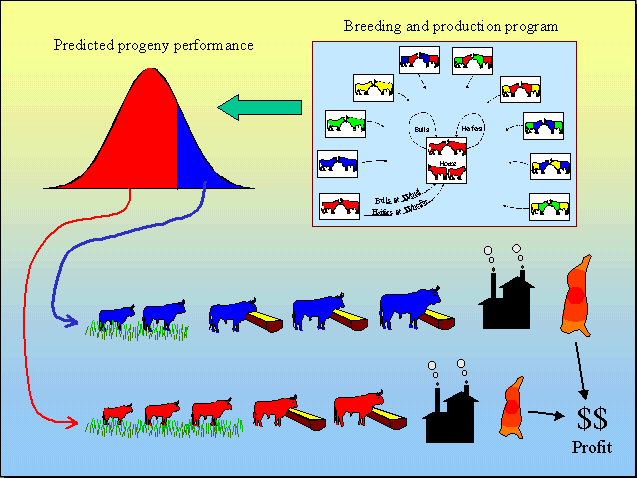
Total Resource Management (TRM) will extend Total Genetic Resource Management (TGRM) to make tactical optimisation decisions in the production and processing sectors, as implied in the following graphic:
For example of TRM prototype, read on. For a more general description of TRM in the context of TGRM, click the graphic, and go to the last few pages of the resulting document.
This is a very simple scenario on feedlotting of cattle. It is set up to illustrate the principles involved, and is NOT supposed to represent a realistic use of TRM. However, its relevance to real life is quite apparent.
A line of steers (say 500 in number) enters the feedlot on day 0, averaging 160Kg. The four circles show the targets weights and day numbers for delivery on four contracts (Say 100 steers per contract):
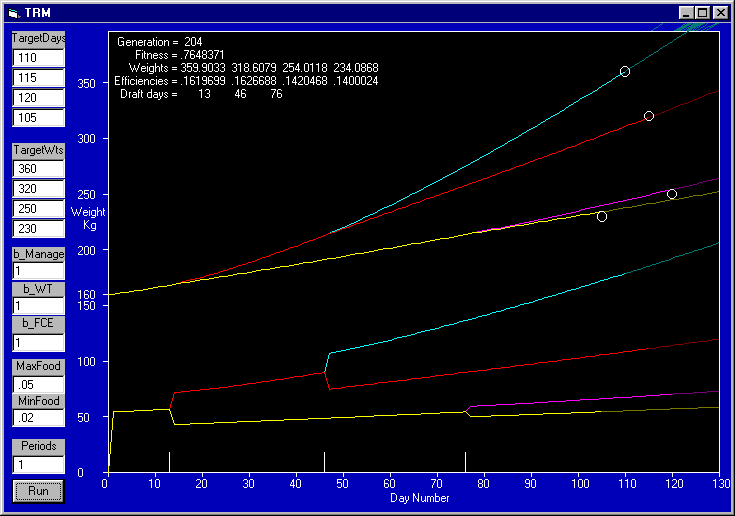
The upper set of curves show growth in body weight, and the lower set of curves show daily food consumption (actually multiplied by 10).
The objective function is driven by three components:
Each component has a weighting (b_Manage, b_WT and b_FCE), arbitrarily set, with multipliers of 1 giving sensible results.
The program uses a genetic algorithm to optimise feeding levels, grouping strategies and drafting dates. Results are contingent on the underlying feeding and growth model used. In the run shown above, all target weights are essentially met. The lower weight targets are overshot slightly because of the favourable effect of this on efficiency. Lowering the weighting on target weight (b_WT) would increase this effect.
In the next run, management costs have been increased, resulting in just two draftings, and at later dates:
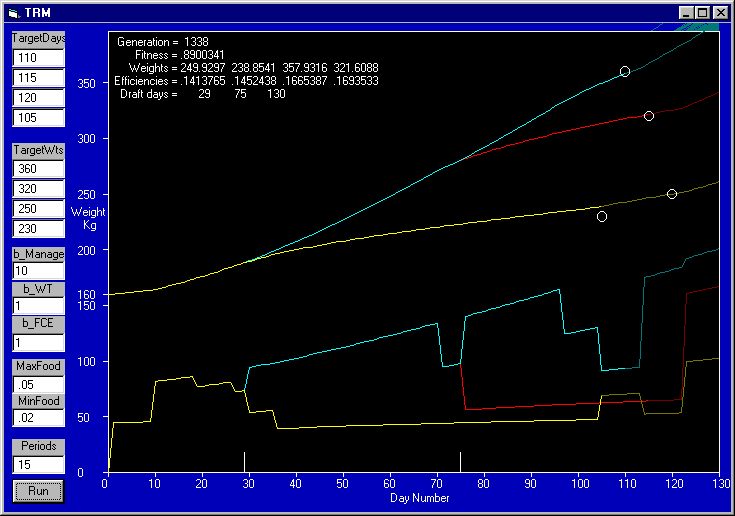
The lower two weight targets are met by one larger line. In this case feeding level has been optimised within management group in each of 15 periods. Notice the typical targetting of average food intake just before a drafting. Reduction in food intake nearer to target slaughter date is characteristic of the growth function used, and improves overall FCE to body weight.
As stated above, this demonstration is highly simplified, and for illustration only. Useful extensions are planned:
Brian Kinghorn, 26 July 1999
Go to the TGRM page.
Go to Brian Kinghorn's homepage.